



Airport transfers to Athens City | Taxi transfers to Athens city
We provide low cost private airport transfers and taxi services from Thessaloniki Airport “Makedonia” (SKG) to Athens city, Greece. Book Online. Wide selection of vehicles. Fixed Prices. Child Seat. Professional drivers. 24/7 Service
The city of Athens is the capital of Greece. Athens is within reach of Thessaloniki airport. The road distance between Thessaloniki International Airport (SKG) and Athens city is approximately 530 km and the average travel duration is 5h 15min.
Our Service
Flexitransfer offers reliable ground transportation and taxi services with elegance, comfort and safety. Pre-book your airport pick up online now, making your reservation easy and straightforward. Arrange your ride to or from Athens in advance and start your stress-free holidays in Greece.
We specialize in transfers for individuals, small-sized groups, business travelers and families with the accent on a courteous and thoroughly professional personal service at the best prices. 24 hours a day – 7 days a week.
Our wide range of vehicle sizes and types, will meet your needs. We operate taxis, sedan cars, estate cars, 8-seater people carriers/minivans, vans, minibuses and executive cars (VIP cars). Travel in style and status, while meeting the highest possible safety requirements.
About Athens
Athens is the historical capital of Europe, with a long history, dating from the first settlement in the Neolithic age. In the 5th Century BC (the “Golden Age of Pericles”) – the culmination of Athens’ long, fascinating history – the city’s values and civilization acquired a universal significance. Over the years, a multitude of conquerors occupied Athens, and erected unique, splendid monuments – a rare historical palimpsest. In 1834, it became the capital of the modern Greek state and in two centuries since it has become an attractive modern metropolis with unrivalled charm.
A large part of the town’s historic centre has been converted into a 3-kilometre pedestrian zone (the largest in Europe), leading to the major archaeological sites (“archaeological park”), reconstructing – to a large degree – the ancient landscape.
The “core” of the historic centre is the Plaka neighborhood (at the eastern side of the Acropolis), which has been inhabited without interruption since antiquity. When you walk through the narrow labyrinthine streets lined with houses and mansions from the time of the Turkish occupation and the Neoclassical period (19th c.), you will have the impression of travelling with a “time machine”. You will encounter ancient monuments, such as the Lysikrates Monument, erected by a wealthy donor of theatrical performances, the Roman Agora with the famed “Tower of the Winds” (1st c. B.C.) and Hadrian’s Library (132 A.D.), scores of bigger and smaller churches, true masterpieces of Byzantine art and architecture, as well as remnants of the Ottoman period (Fetihie Mosque, Tzistaraki Mosque, the Turkish Bath near the Tower of the Winds, the Muslim Seminary, et al.). There are also some interesting museums (Folk Art, Greek Children’s Art, Popular Musical Instruments, Frysira Art Gallery, etc.), lots of picturesque tavernas, cafés, bars, as well as shops selling souvenirs and traditional Greek products.
Continuing from Plaka you arrive at Monastiraki, a characteristic area of “old” Athens, with narrow streets and small buildings where the city’s traditional bazaar (Yousouroum) is held. Close to it is the Psyrri area, a traditional neighborhood which during the past few years has evolved into one of the most important “centres” of the town’s nightlife, with scores of bars, tavernas, ouzeris, clubs, etc.
However, the “heart” of the historical centre is the traditional commercial neighborhood, with more than 2,500 shops of all kinds, which spreads out over the streets surrounding Ermou Street (the city’s best-known commercial street). The western “border” of the area is Athinas Street, where the foodstuff commerce is concentrated, reminding one strongly of the Middle East. Here are situated, among others, the neoclassical mansions of the Town Hall, the Municipal Market (where meat, fish and vegetables are sold) and spacious Kotzias Square.
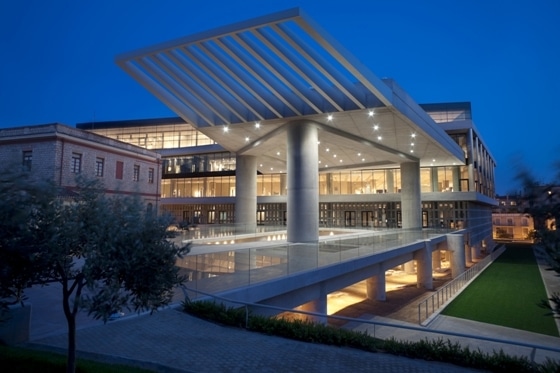
Within the boundary of Athens’ historical centre also are the picturesque neighborhoods of Makriyianni (close to the Acropolis, where the Acropolis Museum stands), Ano Petralona, Theseion (where you will find small interesting museums and scores of cafés, bars and restaurants), Kerameikos and Metaxourgeio, as well as the Gazi area, with the former Gas works, which now have been turned into a cultural centre of the Athens municipality (“Technopolis”).
Downtown
Syntagma and Omonia are the main central squares of the town; they are linked by Stadiou Street and Panepistimiou Avenue, along which some of the town’s most beautiful Neoclassical buildings have been erected. Dominating Syntagma Squareis the Greek Parliament building and in front of it the Monument of the Unknown Soldier, guarded by the Evzones in traditional costume. From this square starts the beautiful National Garden (40 acres), south of which stands the impressive Zappeion Mansion (1874-1888). From there you can continue towards the Presidential Mansion (1897) and thence to the Panathenaikon (Kallimarmaro) Stadium, where the first Olympic Games in modern history were held (1896). From there, crossing the Mets neighborhood, the road leads you to the First Cemetery, the oldest one in Athens, basically an outdoor sculpture display with a wealth of wonderful monumental tombstones by some of the most important sculptors of the 19th and 20th centuries.
From Omonia Square starts Patission street, a busy street with interesting buildings, amongst which are the Neoclassical mansions of the Polytechnic School and the National Archaeological Museum, which ranks among the leading museums in the world and hosts rare art treasures from the Neolithic era up to the Roman period.
Close to the museum is the Exarheia area, a charming and very lively neighborhood, traditional a meeting point and home to many students and artists. From Exarcheia, crossing the Neapoli neighborhood, you can climb the verdant Lycavittos Hill. From its top you have a view of the entire city, all the way to the sea. On the other side of the hill is the Kolonaki neighborhood, whose boundary is Vassilissis Sophias Avenue, one of the most grandiose streets of Athens with beautiful buildings, many museums (Cycladic Art, Benaki, Byzantine and Christian Museum, War Museum, National Gallery) and green areas. In Kolonaki, which is considered to be the most “aristocratic” area of the centre of Athens, you will find many shops selling expensive brands and high couture, modern restaurants, bars and cafés, while it is worthwhile to take a stroll through the central streets with their art déco, art nouveau and interbellum buildings.
Do I have to wear a mask in transports – inside taxi or private hired vehicles – in Greece?
(2022 guidance on the use of face masks in Greece – Covid19 update)
TAXIS / PRIVATE TRANSFERS / MINIVANS / MINIBUSES / CITY BUSES
Our staff will wear a face covering inside the taxis and all private-hired cars for the duration of your journey. Our driver will use hand satinizer before and after any transaction or contact with your luggage etc. In Greece, it is the law that you must wear either a face covering or face mask even if you are vaccinated inside the taxis or private hired cars. Exemptions include people who have medical issues (trouble breathing, unability to wear a mask properly etc), children under the age of three (3) or you have any other legitamate reason not to – however please note that proof maybe requested by local authorities. Our drivers treat everyone with respect and compassion and understand if it is not immediately obvious that some people are not able to wear face covering for medical reasons.
AIRPORTS / AIRPLANES / TRAINS / INTERCITY BUSES:
From Wednesday 1st of June 2022 and after, Greek state decided and it is the law now that masks are not mandatory.
SHIPS / FERRYBOATS
From Thursday 2nd of June 2022 and after Greek state decided and it is the law now that masks are not mandatory, but it is strongly reccomended.
Where do I have to wear mask in Greece?
(in use after 1st of June 2022 for summer/autumn period – Covid19 update)
From Wednesday 1st of June 2022 and after, Greek state decided and it is the law now that:
– Masks are NOT mandatory anymore INDOORS. This means that you DON’T have to wear a facemask anymore, if you want to visit a coffee shop, a restaurant, a beach bar, a shop, hotel or supermarket.
– You MUST wear a mask, if you visit the following places: public hospital, pharmacy, private clinic, doctor’s office, medical centre, retirement and nursing home. You must also wear a mask, when using public transportation (public bus, taxi, chauffeurred-driven vehicles etc)