



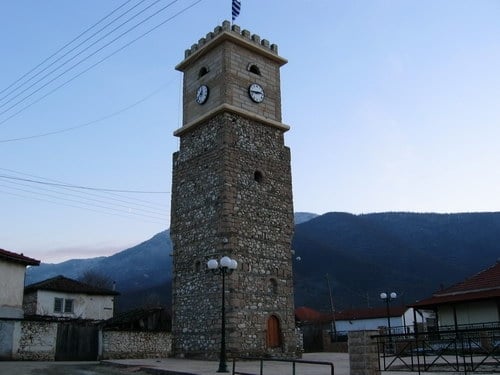
Agkistro is the northernmost village of the prefecture of Serres. Built at the foot of the homonymous mountain, it dominates right next to the border line with neighboring Bulgaria. The history of the village is lost in the depths of the ages. During the reign of Philip II of Macedonia, in the 4th century BC, they worked on Mount Agistro, iron and gold mines, which, together with Paggaio, financed the Pan-Hellenic expedition against the Persians, with the campaign of Alexander the Great in Asia. At the same time, the hot springs, which ensure a continuous human presence in the course of centuries, are also being utilized. The stone bath dates back to the Byzantine era (950 AD), and the tower in the center of the village, which served as a clock in the 14th century. with the beige of the region and his harem, enjoy the warm waters of the bath. According to tradition, the stone tower was used as a prison and as a place of execution. At its four corners, there are still the stone lobbies, of which the arches were placed, for the executions.
Upon the end of the Balkan Wars, in the summer of 1913, a few meters north of the village was defined the border between Greece and Bulgaria. The years that followed, and due to the cold relations with the neighbors, the region was a full militarized zone. In 1923, the arrival of refugees from the Pontus area after the Asia Minor disaster, boosts the village’s population, boosting the local economy. In 1920, the village’s population reached 965 inhabitants, and in the following census of 1928 the residents reached 1.240. Pre-war in the village of Agistrou, four settlements still belonged. Upper Karydia, Kato Karydia, Damaskino and Krassohori. After 1935 on Mount Agistro, fortifications were built under the Metaxas Line. In the current administrative boundaries of the village of Agistro, there are the fortresses Karatas and Three Vrises. The strong presence of the army is reflected in the 1940 census where the total population of the village amounts to 1,915 people, including officers and reservists.
With the declaration of the Greek-Italian war (1940), Agistro and his four settlements were evacuated by the population, due to the military operations and the impending German invasion. In the early days of April 6, 1941, the few fortress guards, above Agistro, wrote new pages of glory and heroism, stunning the Nazi hordes of iron gates. All agglomerations of Agistro expired in the wake of the Second World War and the devastating civil war that followed, while Agistro suffered serious disasters. After the liberation and the end of the civil war, those of the inhabitants of Agistro returned, almost obscured their village. With money from the Marshall Plan, with the stubbornness and love of his people, Hughes was rebuilt almost from scratch, and the normal lifestyles resumed, with the population reaching 441 inhabitants (1951). The first post-war years, Agistro and the nearby Promachon, remained isolated from the rest of Serres because of their designation as a military forbidden zone. The difficulties of post-war Greece, the full militarization of the border area, have resulted in the population of the village becoming more numerous, as many have chosen to settle in large urban centers or abroad.
The image of decay begins to reverse after 1990. The complete normalization of relations with Bulgaria and the demilitarization of the region combined with the “shift” to various forms of alternative tourism, gave the opportunity to Agistro to use the … “gifts” that naturally gave it to him, changing the downward course and creating conditions for growth and prosperity.