



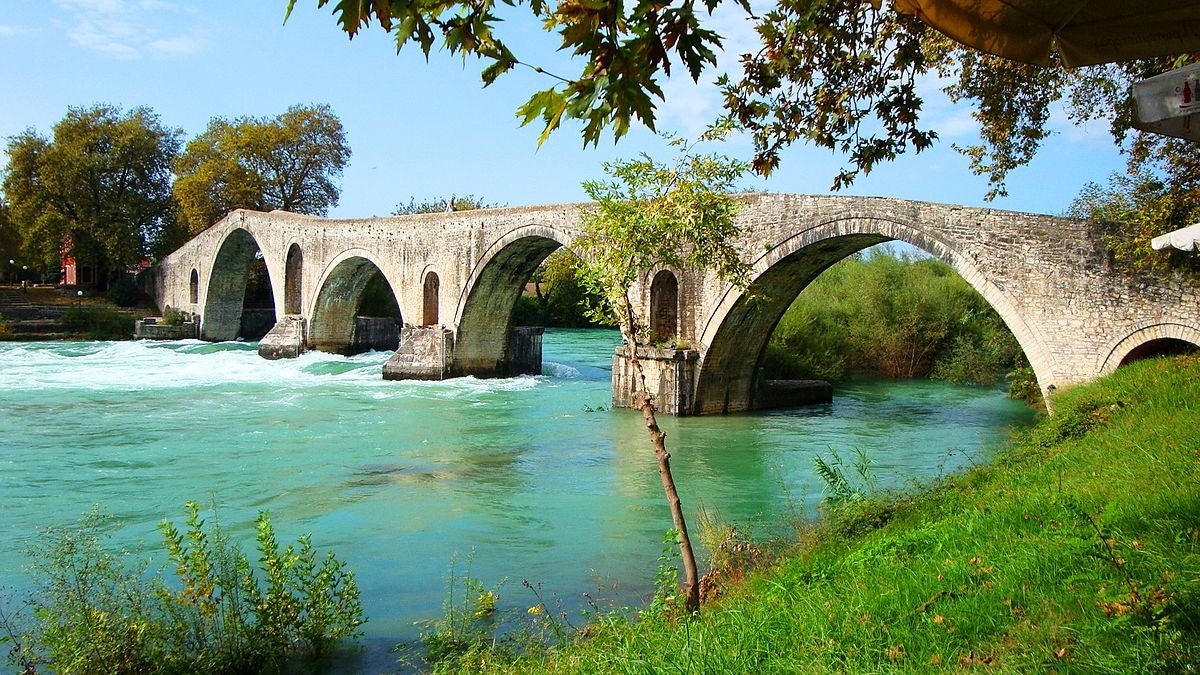
The history of Arta is lost in the depths of the ages. From the Homeric years, this place was inhabited by the Dyopes and the hills from the rugged Athamanes.
In the place of the present lower city there was a settlement called Amvrakia . Amvrakia was built in the 7th century BC. from Gorgos, the son of the tyrant of Corinth Kipselos. After the colonization of the Corinthians in Amvrakia, the city became a major commercial, administrative and cultural center.
During the Hellenistic times, the king of Molossia Pyrros made it the capital of his state in 295 BC. Pyrros gave international glamor to the city, as well as to the whole of Epirus and decorated Amvrakia with important buildings.
In 171 BC was captured by the Romans and since then its decadence began. With the founding of Nicopolis, many of the residents settled there. It appears to have been inhabited again after the Goths invasion (6th century), in order to experience new acne upon Mikhail of Paphlagonos (1,040 BC) when the inhabitants of Nikopolis joined the Bulgarians.
After the fall of Constantinople by the Franks (1.204), Arta became the capital of the Despotate of Epirus , founded by Michael Angelos Komninos. In 1449 it was captured by the Turks.
During the Revolutions of 1821, the city but mainly the mountainous region of Tzoumerka and Radovyzi were the base of many fighters. But with the devastation of the Greeks and the Philhellenes in the village of Petas, he stopped all efforts to prevail in the region, which remained under Turkish occupation. Arta regained its independence with the Berlin Treaty in 1881 , and in 1883 the homonymous county was created.
The city today, capital of the homonymous prefecture, is located 365 km from Athens. It is built on the left bank of the river Arachthos and spreads amphitheatrically at the foot of the hill of Peranthis. Its privileged position, the euphoria of its soil and the climate were the main reasons that gave the city a continuous life, from the 9th century. B.C. until today.
Known is Arta from the legend of her Bridge, which “built it all day, the night was ruined” and only sent away when it was “built” (the sacrifice) of the founder’s wife.
Do I have to wear a mask in transports – inside taxi or private hired vehicles – in Greece?
(2022 guidance on the use of face masks in Greece – Covid19 update)
TAXIS / PRIVATE TRANSFERS / MINIVANS / MINIBUSES / CITY BUSES
Our staff will wear a face covering inside the taxis and all private-hired cars for the duration of your journey. Our driver will use hand satinizer before and after any transaction or contact with your luggage etc. In Greece, it is the law that you must wear either a face covering or face mask even if you are vaccinated inside the taxis or private hired cars. Exemptions include people who have medical issues (trouble breathing, unability to wear a mask properly etc), children under the age of three (3) or you have any other legitamate reason not to – however please note that proof maybe requested by local authorities. Our drivers treat everyone with respect and compassion and understand if it is not immediately obvious that some people are not able to wear face covering for medical reasons.
AIRPORTS / AIRPLANES / TRAINS / INTERCITY BUSES:
From Wednesday 1st of June 2022 and after, Greek state decided and it is the law now that masks are not mandatory.
SHIPS / FERRYBOATS
From Thursday 2nd of June 2022 and after Greek state decided and it is the law now that masks are not mandatory, but it is strongly reccomended.
Where do I have to wear mask in Greece?
(in use after 1st of June 2022 for summer/autumn period – Covid19 update)
From Wednesday 1st of June 2022 and after, Greek state decided and it is the law now that:
– Masks are NOT mandatory anymore INDOORS. This means that you DON’T have to wear a facemask anymore, if you want to visit a coffee shop, a restaurant, a beach bar, a shop, hotel or supermarket.
– You MUST wear a mask, if you visit the following places: public hospital, pharmacy, private clinic, doctor’s office, medical centre, retirement and nursing home. You must also wear a mask, when using public transportation (public bus, taxi, chauffeurred-driven vehicles etc)