



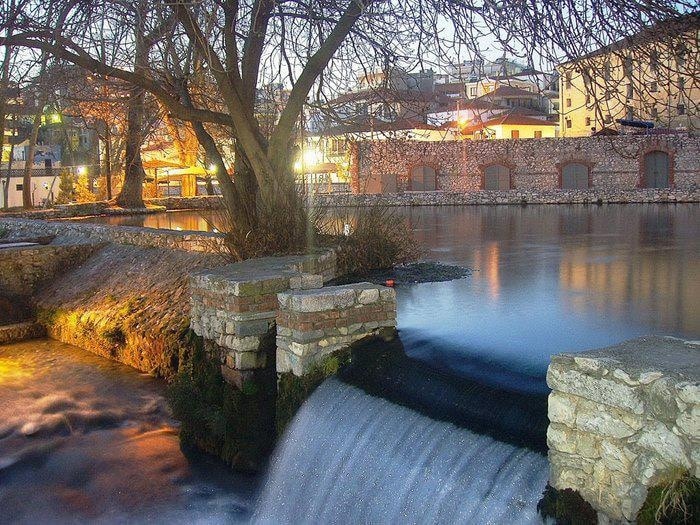
The prefecture of Drama is located at the northeastern edge of Greece, on the border with Bulgaria. It is the richest county in terms of the natural environment. It is enclosed by the mountains of Rodopi to the north, to Meonio and Orbilo to the west, to Pangaio to the south and to the eastern basins of Lebanon. The mountainous mass that dominates the highest point of the horizon is Falakro, the “mountain symbol” of Drama.
It administratively belongs to the Region of Eastern Macedonia and Thrace and is divided into eight municipalities (Drama, Kato Nevrokopi, Prossotsani, Nikiforos, Paranesti, Doxato, Kalambaki, Sitagron) and a community (Sideronero).
The county is essentially rural. There are large arable land in the plains that extend mainly to its southern part. The full exploitation of its water resources (especially the Nestos and Aggitis rivers, Kefalari springs) and the use of modern farming methods have significantly improved the agricultural economy in recent years.
The products grown are mainly cereals, cotton, industrial tomatoes, tobacco, vines, fruit and vegetables. The most famous products of the area are the beans and potatoes of Kato Nevrokopi, while the wine growing in recent years has acquired a new dynamic, already known by the famous wines of Drama of international recognition.
The livestock production is an important place in the prefecture, where the small family farm is dominated by traditional forms, mainly sheep and goats, bovines and pigs are bred, while modern units produce excellent quality cheese products,
In a county, however, most of which is covered by forests , the forest production could not be missed. The region has the richest forests in Greece. The main forest products come from spruce forests, pine, beech, oak and vitiligo from the local wood industries.
The largest but economic interest is the prefecture of marble. Today it is the main element of its development. Marble mining and processing units, one of the largest and most modern in the country, have been established in the region, presenting a large export activity to the Arab countries, Europe, the USA and Japan. The subsoil of the county also includes remarkable mineral wealth in industrial minerals. Important is the manganese deposits at the foothills of Falakro, uranium deposits and industrial minerals in the Paranesti area, as well as the lignite field that has been identified in the area of Mavrovoufis,
In the capital there are the main services of administration, education, nursing and sports. The city has a modern hospital, a network of sports facilities with closed gyms, a swimming pool, stadiums and the Department of Forestry of the Technological Educational Institute of Kavala.
A network of cultural infrastructures with exhibition halls, libraries, conservatory, cinema hall provides, in cooperation with active local cultural clubs, a variety of events to preserve local traditions and highlight contemporary art.
Do I have to wear a mask in transports – inside taxi or private hired vehicles – in Greece?
(2022 guidance on the use of face masks in Greece – Covid19 update)
TAXIS / PRIVATE TRANSFERS / MINIVANS / MINIBUSES / CITY BUSES
Our staff will wear a face covering inside the taxis and all private-hired cars for the duration of your journey. Our driver will use hand satinizer before and after any transaction or contact with your luggage etc. In Greece, it is the law that you must wear either a face covering or face mask even if you are vaccinated inside the taxis or private hired cars. Exemptions include people who have medical issues (trouble breathing, unability to wear a mask properly etc), children under the age of three (3) or you have any other legitamate reason not to – however please note that proof maybe requested by local authorities. Our drivers treat everyone with respect and compassion and understand if it is not immediately obvious that some people are not able to wear face covering for medical reasons.
AIRPORTS / AIRPLANES / TRAINS / INTERCITY BUSES:
From Wednesday 1st of June 2022 and after, Greek state decided and it is the law now that masks are not mandatory.
SHIPS / FERRYBOATS
From Thursday 2nd of June 2022 and after Greek state decided and it is the law now that masks are not mandatory, but it is strongly reccomended.
Where do I have to wear mask in Greece?
(in use after 1st of June 2022 for summer/autumn period – Covid19 update)
From Wednesday 1st of June 2022 and after, Greek state decided and it is the law now that:
– Masks are NOT mandatory anymore INDOORS. This means that you DON’T have to wear a facemask anymore, if you want to visit a coffee shop, a restaurant, a beach bar, a shop, hotel or supermarket.
– You MUST wear a mask, if you visit the following places: public hospital, pharmacy, private clinic, doctor’s office, medical centre, retirement and nursing home. You must also wear a mask, when using public transportation (public bus, taxi, chauffeurred-driven vehicles etc)